

Shaped like a shoe, or a foot, Moccasin Bend lies where the mountain, the river, and the plains meet, its fertile land a natural place for people to gather. Throughout the region’s history, this place has been a hub, named a Historic National Landmark in 1986 and authorized as a National Archeological District in 2003. Archaeological studies connect our past to the present, reflecting the cultural history of indigenous communities and their struggles for autonomy, safety, and freedom. When threatened they can also become rallying points for descendants and for the public, reminding us of the power of community when they are protected through public discourse and meaningful local, county, state, federal and tribal coordination.
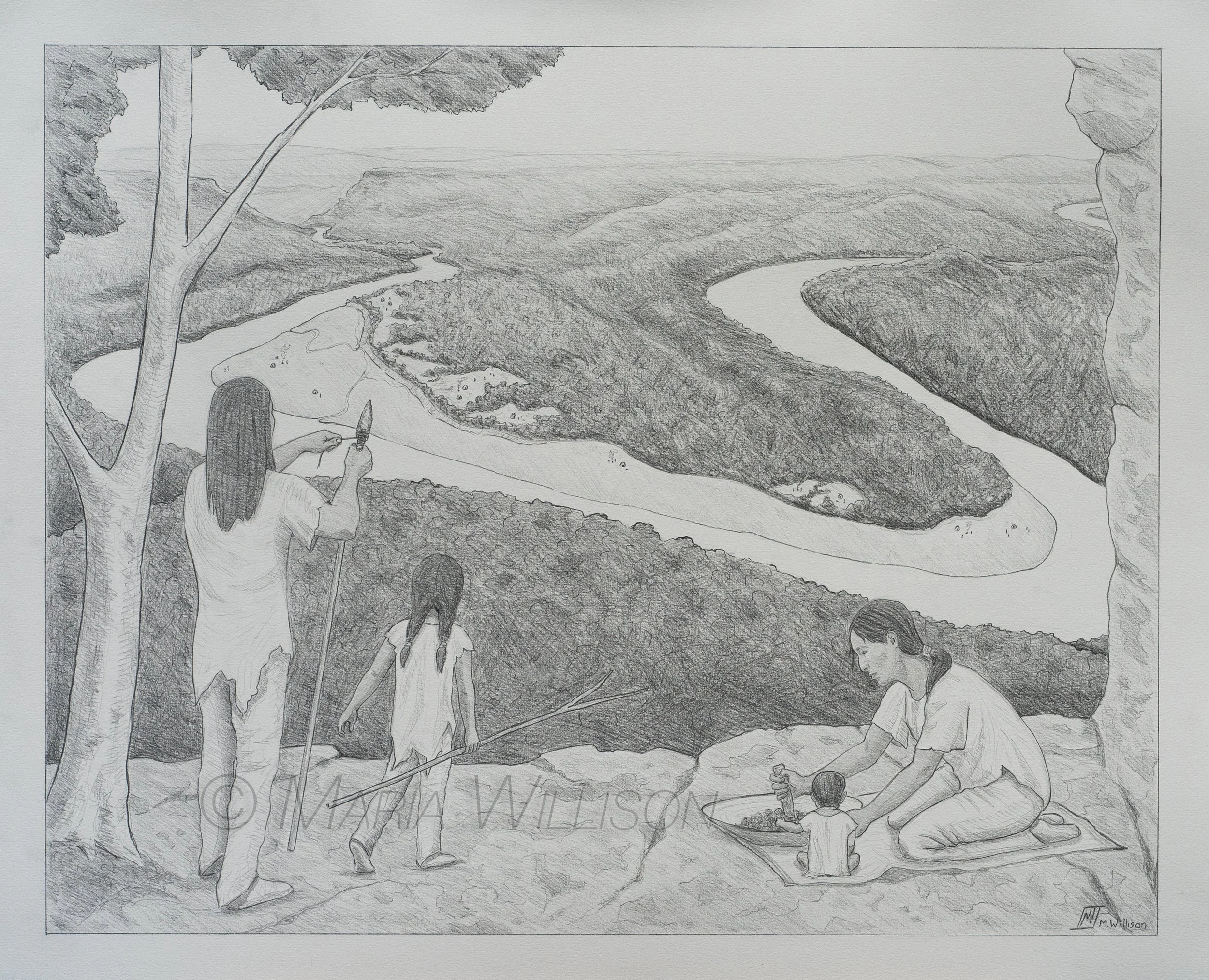
Archaeology tells us that people have been living on Moccasin Bend for over 12,000 years but without written records about their life it’s hard to imagine what their lives were like. Prehistoric cultures on Moccasin Bend are divided into four time periods; PaleoIndian, Archaic, Woodland, and Mississippian people.
During the Paleo era it is thought that the first people began living in this area, between 12,000 B.C. and 8,000 B.C.. They were hunters and gatherers, traveling together following food sources. Working stone to create tools and weapons, they hunted animals, using each part to provide food, clothing, tools, and shelter. An animals’ hide was worked to become leather for clothes and dwelling walls; sinew, or muscle, was wrapped, or hafted, to connect projective points to spears, and antlers were abraded with stones to become tools or weapons. They collected berries, nuts, roots and herbs along the way, camping near streams, lakes, or rivers.
The Archaic era saw an increase in groups of families gathering together, staying longer in each place as evidenced by larger piles of shells from the abundance of freshwater mussels they ate. The atlatl was developed, an early advance in weaponry that significantly increased the distance and force that one could achieve from a thrown spear, increasing the scope of prey they could hunt. Evidence suggested that they began building huts and making clothing, baskets, mats, and fish traps from plants and animal skins. Archaeological digs showed an increase in trading as evidenced by the presence of non-native stones and rock tools. Fire pits became more significant as groups stayed longer, digging them out and lining them with rocks. “Fire-cracked” rocks began being used to boil food, dropped in after having been heated in the fire.
The Woodland era, between 700 B.C. to 1,000 A.D., was a period that reflected significant advances in quality of life as people began to produce and store their own food, becoming farmers, clearing land and caring for it. Stone axes and hoes were used to clear land to form small villages, felling trees, and tending crops planted with digging sticks while they continued to harvest wild plants and herbs, as well as hunting and fishing. Houses were more permanent and purposeful, circular with large posts supporting conical roofs and smaller posts outlining the exterior walls made of plant materials often covered in mud. Digs indicated continued increases in long-distance trade as evidenced by the presence of new plants, copper, shells, rocks, quartz, and other ornamental items.
As they transitioned to more established villages Woodland people began making cooking and storage pots out of clay, likely having identified its use as a protective cover for their walls. Mixed with sand and crushed limestone, or tempered, it was hardened, preventing it from cracking when heated in a fire. They valued their use so highly that broken pottery was used to temper new clay. Ropes of rolled clay could be coiled to create large pots, pinched into smaller ones, their exteriors often designed with incised patterns, impressions, or smooth, polished surfaces.
Advances in hunting continued as bows and arrows were made from bending hardwood saplings attached to opposite ends of animal tendon or plant fibers. Feathers were split and tied to the ends of arrows, called fletching, as the other ends were armed with arrowhead, small, sharpened stone points.
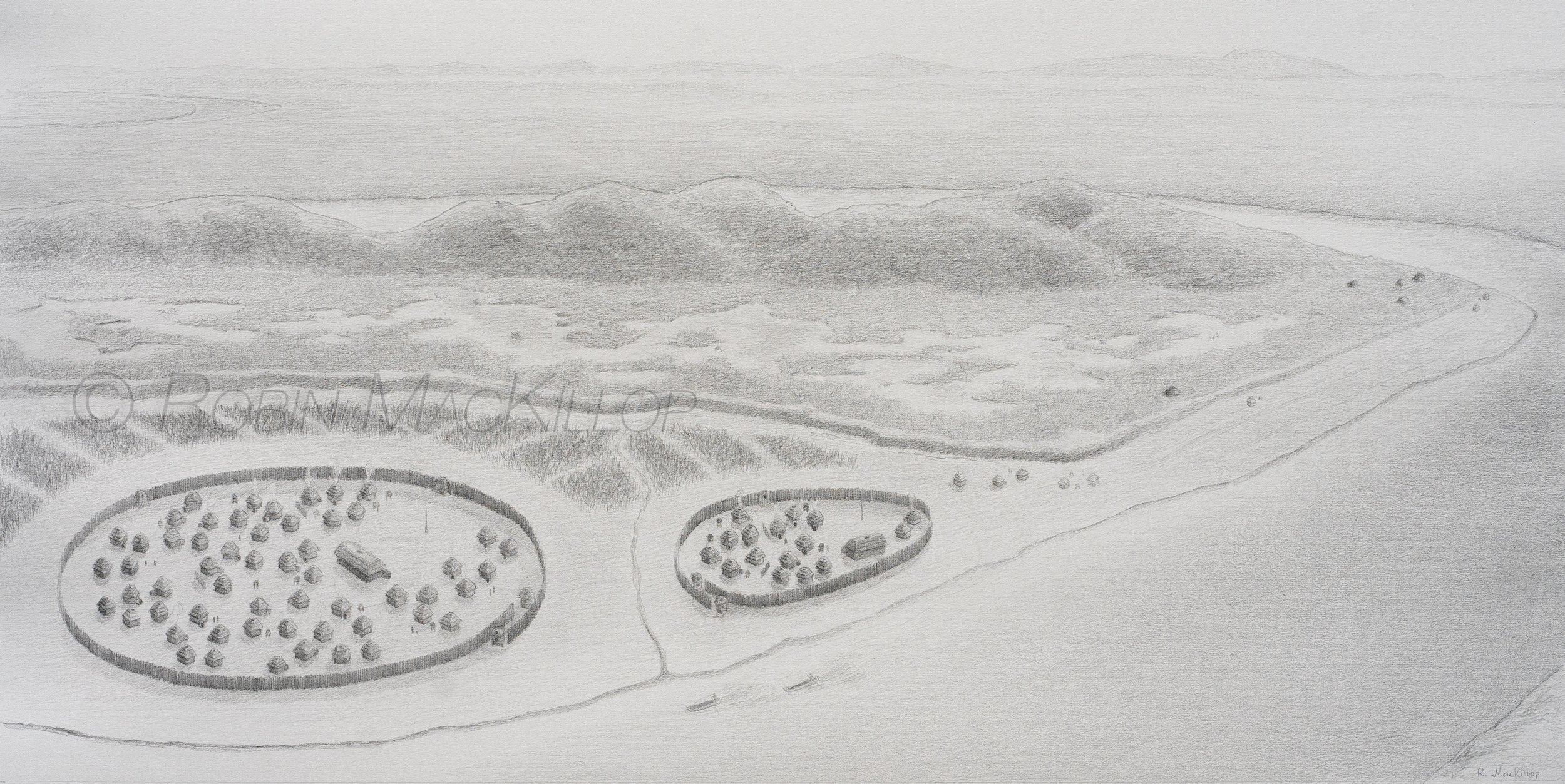
Tribal hierarchy became important with villages comprising multiple large, rectangular mounds, each flat top with a structure, elevating the chief’s family house, a political council building, or religious temple. People built houses around the mounds with walls made from tree poles woven together with smaller branches and covered with clay plaster. Floors and fire pits were made of clay with seats frequently woven into the wattle-style walls and covered.
Villages were often surrounded by palisades, wooden walls that protected them. Corn, beans, and squash gardens surrounded the village and dug-out canoes reflect extensive travel up and down the river. Pottery continued to change, including the advances of tempering, a process combining shells and hematite, a local iron ore, as well as the addition of handles and long-necked bottles. More elaborate decorations, including finger markings, stamping, incised and punched patterns indicate specialization as artists established their roles in communities. Unique designs were used, including symbols representing circles, hands, eyes, crosses, suns, birds and serpents. Stone and clay pipes were made resembling animals, and gaming stones, beads, ear spools and gorgets with designs that defined family, political, and tribal memberships.
Prior to the arrival of the Spanish conquistadors, the Coosa had established trade relationships with other Mississippian cultures, resulting in the exchange of ideas, innovations, and styles, including variations found in pottery and artifacts discovered in excavations. Europeans arrived in the Tennessee Valley in 1540, Spanish conquistadors finding the Coosa Chiefdom, a productive, creative, and highly organized civilization encompassing much of the Southeast. Hernando de Soto (1540) led the earliest expeditions into the Coosa territory, followed by Tristan de Luna (1560), and Juan de Pardo (1566) who found the villages and populations already significantly diminished due to the devastation of the European-borne epidemics, including influenza and plagues.
As the Coosa Chiefdom fell apart, survivors came together in smaller villages, developing their own unique cultures and becoming the forerunners to the Native American tribes which would emerge as a dominant force on the wilderness frontier of the Revolutionary War.